Research
Our long-term goal is to decode the human genome. We combine computational method development and experimental technology to understand how non-coding regulatory elements drive disease.
Artificial Intelligence for Liquid Biopsy
Circulating cell-free DNA (cfDNA) is released into the peripheral blood after cellular death and recycled every few minutes for up to 12 hours. The collection of cfDNA fragments represents a real-time in vivo snapshot of the genome from cells contributing to cfDNA, and cfDNA is not randomly fragmented, but reflects the epigenetic state of those source cells.
Millions of cfDNA sequencing datasets are generated in clinics every year. To leverage these datasets, we are developing computational methods based on generative AI to reconstruct cellular epigenomes and transcriptomes from a single cfDNA assay. This enables non-invasive identification of biomarkers for the early diagnosis and prognosis of cancers, neurodegenerative diseases, and neuroinflammatory conditions.
Key tools & publications
- cfDNA Regional Motif Diversity Score · Journal of Clinical Investigation (2026)
cfDNA regional motif diversity predicts immunotherapy response in head and neck cancer
- FinaleToolkit · Bioinformatics Advances (2025)
High-speed toolkit for extracting cfDNA fragmentation features
- FinaleMe · Nature Communications (2024)
Predicts DNA methylation from cfDNA fragmentation patterns
- CRAG · Genome Medicine (2022)
De novo characterization of cfDNA fragmentation hotspots
- FinaleDB · Bioinformatics (2020)
Database and browser for cfDNA fragmentation patterns
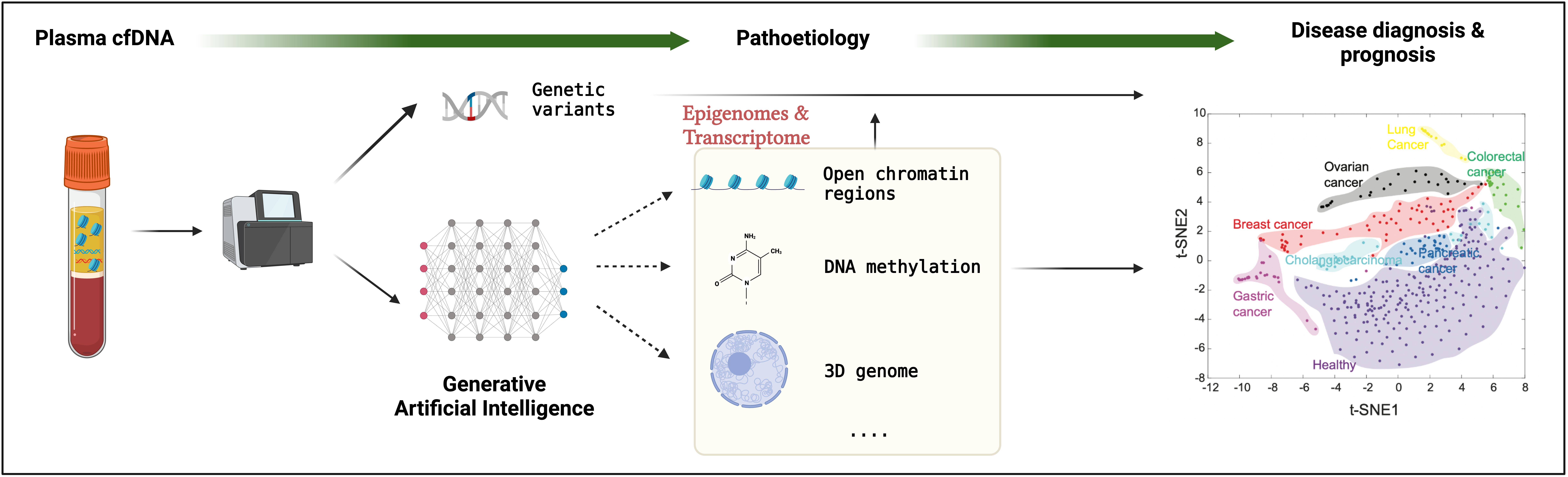
Utilizing cfDNA fragmentation patterns and AI to monitor gene regulation during disease initiation and progression.
Single-Cell & Single-Molecule Multi-omics
Epigenetic modifications, including DNA methylation, histone modifications, and 3D genome topology, combine with genetic content to determine transcription factor binding and gene regulation. However, gene activation or repression potential cannot be entirely predicted by looking at a single molecular measurement, and the interactions between different epigenetic marks are currently studied either in homogenous cultured cells or bulk tissues that average the readout.
We develop technologies to simultaneously capture multiple molecular measurements in the same single cell. We have built several multi-omic platforms and continue developing more powerful approaches to dissect the regulatory roles of non-coding elements in heterogeneous tissues and identify therapeutic targets for human diseases.
Key tools & publications
- NOMe-HiC · Genome Biology (2023)
Joint profiling of DNA methylation, chromatin, and 3D genome in a single molecule
- Methyl-HiC · Nature Methods (2019)
Nature Methods "Method of the Year 2019" highlight

Single-cell multi-omics technologies to understand gene regulation and identify therapeutic targets.